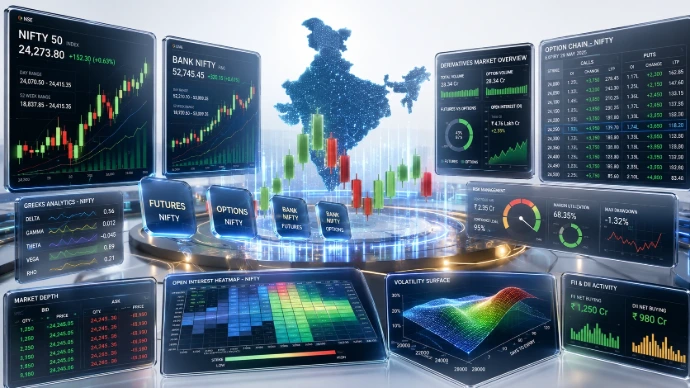
Derivative Trading in India: Complete Guide to Futures & Options Market
Master the fundamentals of derivative trading, understand futures and options, learn proven F&O strategies, and navigate the Indian derivative market with confidence. Your complete educational resource for informed trading decisions.
What is Derivative Trading?
Understanding the core concept behind one of the world's largest and most dynamic financial markets — the derivative market.
Derivative trading involves buying and selling financial contracts whose value is derived from an underlying asset. These underlying assets can be stocks, indices, commodities, currencies, or interest rates. Unlike direct asset ownership, derivatives are contracts between two or more parties that derive their value from the performance of the underlying entity.
In the Indian derivative market, traders use instruments like futures contracts and options contracts to speculate on price movements, hedge existing portfolio risk, or engage in arbitrage opportunities. The derivative market in India is primarily governed by the Securities and Exchange Board of India (SEBI) and operates through exchanges like the National Stock Exchange (NSE) and Bombay Stock Exchange (BSE).
For example, if a trader believes that the Nifty 50 index will rise from its current level, they can buy a Nifty futures contract or purchase a Nifty call option instead of buying all 50 stocks individually. This provides leverage, meaning they can control a large position with a relatively smaller amount of capital known as margin.
According to NSE data, India has emerged as the world's largest derivative market by volume, with billions of contracts traded annually. This explosive growth underscores the importance of understanding derivative trading for every market participant.
Key Components of Derivative Contracts
Underlying Asset
The financial instrument from which the derivative derives its value — stocks, indices, commodities, currencies, or bonds.
Contract Value
The total monetary value of the contract, calculated as price of the underlying asset multiplied by the lot size.
Expiry Date
The date on which the contract expires and must be settled. Monthly contracts expire on the last Thursday in India.
Margin Requirement
The collateral deposit required by the exchange to initiate and maintain a derivative position.
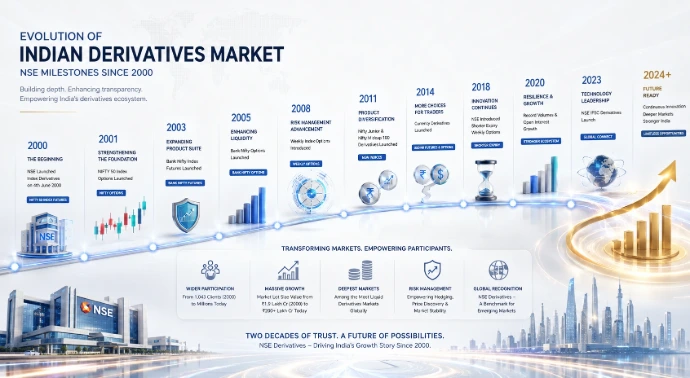
History of Derivative Trading in India
The Indian derivative market has evolved remarkably since its inception — from informal forward trading to a world-leading exchange-traded derivatives ecosystem.
Types of Derivatives in India
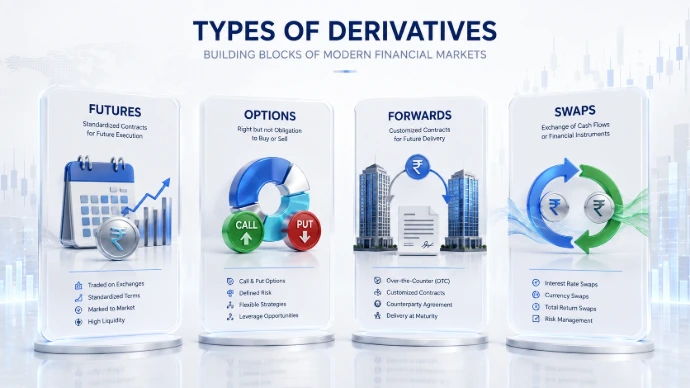
The Indian derivative market offers four primary types of instruments. Understanding each is essential for informed trading decisions.
Futures Contracts
A futures contract is a standardized legal agreement to buy or sell an underlying asset at a predetermined price on a specified future date. Both buyer and seller are obligated to honour the contract at expiry.
Key Features
- Standardized contracts traded on exchanges
- Obligation for both buyer and seller
- Daily mark-to-market settlement
- Margin-based trading with leverage
- Cash settled in India (mostly)
Advantages & Risks
Advantages: Simple structure, transparent pricing, high liquidity, no premium cost, profit from both directions.
Risks: Unlimited loss potential, daily margin requirements, compulsory settlement at expiry.
Options Contracts
An options contract gives the buyer the right, but not the obligation, to buy (call) or sell (put) an underlying asset at a specified strike price on or before the expiry date.
Key Features
- Right but not obligation for buyer
- Premium paid upfront by buyer
- Call Options (bullish) & Put Options (bearish)
- Multiple strike prices available
- Weekly and monthly expiry cycles
Advantages & Risks
Advantages: Limited risk for buyers, multiple strategy combinations, flexibility, hedging capability.
Risks: Time decay erodes value, sellers face unlimited risk, complexity of option Greeks.
Forward Contracts
A forward contract is a customized private agreement between two parties to buy or sell an asset at a specified price on a future date. Unlike futures, forwards are OTC instruments — not traded on exchanges.
- Customized, non-standardized contracts
- No margin requirements typically
- Settlement at maturity only
- Counterparty risk exists
Primarily used by corporates, banks, and institutions for customized hedging needs.
Swap Contracts
A swap is a derivative in which two parties exchange cash flows or financial instruments over a period. Interest rate swaps and currency swaps are the most common types.
- Exchange of cash flow streams
- Primarily OTC instruments
- Used by corporates and institutions
- Regulated by RBI and SEBI in India
Efficient for managing interest rate exposure, currency risk, and optimizing corporate cash flows.
Major Derivative Segments in India
The Indian derivative market is divided into four major segments, each serving distinct trading and hedging purposes.
Stock Futures & Stock Options
Individual stock derivatives on 200+ NSE-listed stocks. Popular F&O stocks include Reliance, TCS, HDFC Bank, Infosys, ICICI Bank, Bajaj Finance, SBI, and Tata Motors.
Index Futures & Index Options
Derivatives on Nifty 50, Bank Nifty, FinNifty, Sensex and more. The most actively traded segment with weekly and monthly expiry cycles.
Currency Derivatives
Futures and options on USD/INR, EUR/INR, GBP/INR, JPY/INR. Used by importers, exporters, and forex traders for hedging and speculation.
Commodity Derivatives
Trade on MCX (metals, energy) and NCDEX (agricultural). Popular: Gold, Silver, Crude Oil, Natural Gas, Copper, Zinc, Cotton, Soybean.
Interest Rate Derivatives
Based on government securities and T-bills. Used by banks and institutions for managing duration risk and fixed-income portfolio optimization.
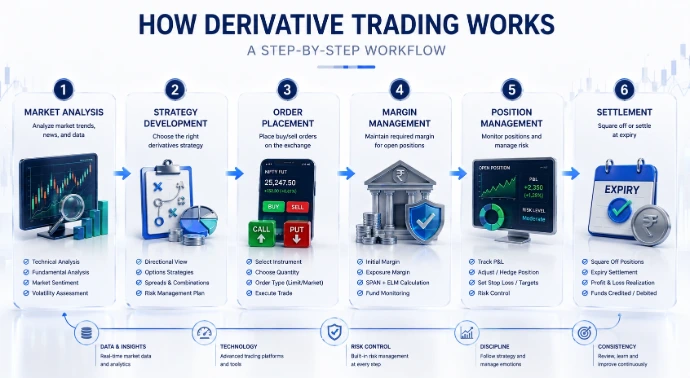
How Derivative Trading Works
Understanding the complete workflow is essential before placing your first derivative trade in the Indian market.
Why Traders Use Derivatives
Derivatives serve multiple purposes — hedging, speculation, arbitrage, and income generation in the financial ecosystem.
Hedging
Protect portfolios and business against adverse price movements. Buy put options as insurance against market crashes.
Example: Exporter hedges INR appreciation via USD/INR futures.
Speculation
Profit from expected price movements without owning the underlying. Leverage amplifies both potential gains and losses.
Example: Buying Nifty call options before a bullish event.
Arbitrage
Exploit price discrepancies between related markets for risk-free profits. Buy in one market, sell simultaneously in another.
Example: Cash-futures arbitrage when premium is unusually high.
Income Generation
Options sellers collect premiums as income. Covered calls, iron condors, and credit spreads generate consistent theta income.
Example: Selling weekly OTM Nifty options for premium collection.
Portfolio Protection
Institutional investors buy index puts as insurance during uncertain periods to protect against significant drawdowns.
Example: Fund manager buys Nifty puts before election results.
Risk Management
Define exact risk parameters through position sizing, delta hedging, and spread strategies for systematic exposure management.
Example: Bull call spreads to limit both max profit and max loss.
Benefits of Derivative Trading
Derivative trading offers key advantages making it an attractive segment for traders and investors in India.
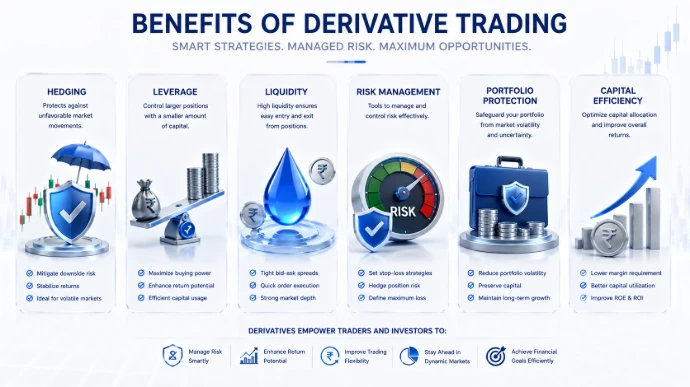
Leverage & Capital Efficiency
Control large positions with a fraction of capital. Margin-based trading amplifies market exposure, maximizing returns on deployed capital while trading multiple instruments simultaneously.
High Liquidity
Nifty and Bank Nifty options are among the most liquid globally. Tight bid-ask spreads ensure efficient, cost-effective trade execution at any scale.
Hedging & Protection
Protect stock portfolios against downturns using put options. Derivatives serve as insurance for existing investments during uncertain markets.
Strategic Flexibility
From directional bets to non-directional income strategies — combine options for custom risk-reward profiles tailored to any market condition.
Risks of Derivative Trading
Derivatives carry substantial risks. Understanding and managing these risks is essential for survival and success.
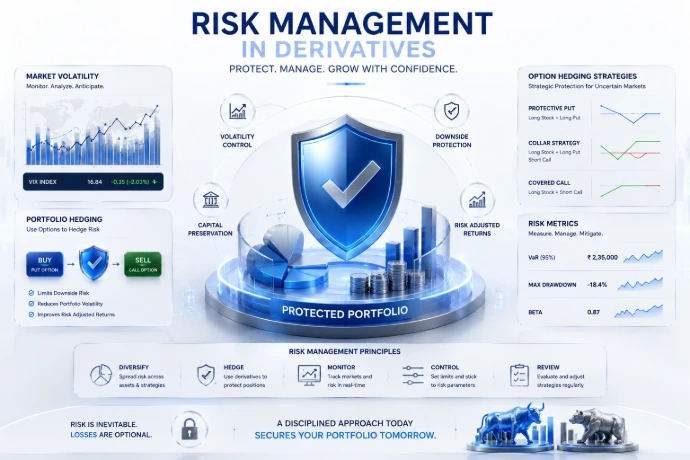
Leverage Risk
Leverage amplifies losses equally as gains. Small adverse moves can cause losses exceeding initial margin, triggering margin calls.
Market Volatility
Sudden extreme movements from earnings, geopolitical events, or policy changes can trigger violent price swings and rapid capital erosion.
Time Decay (Theta)
Options lose value daily. Decay accelerates near expiry, especially for OTM options. Buyers are adversely affected; sellers benefit from theta.
Margin Calls
Positions moving against you trigger margin calls. Failure to add funds leads to forced liquidation at unfavourable prices by the broker.
Liquidity Risk
Far OTM options and less popular stocks may have wide spreads, making entry/exit difficult at desired prices.
Emotional Trading
Fast-paced trading triggers revenge trading, overtrading, or holding losers too long. Discipline and a plan are non-negotiable.
⚡ Important Risk Disclaimer
Derivative trading involves substantial risk of loss and is not suitable for all investors. According to SEBI studies, a significant majority of individual F&O traders incur net losses. Past performance does not guarantee future results. Only trade with capital you can afford to lose. Seek independent financial advice if needed.
Futures vs Options: Comprehensive Comparison
Understanding the fundamental differences between futures and options contracts is critical for making the right trading decisions.
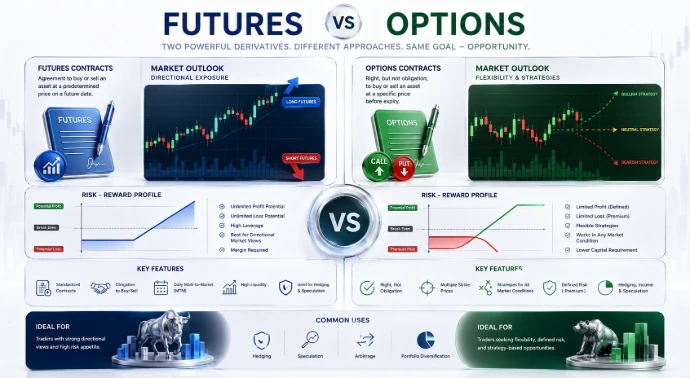
| Parameter | Futures Contract | Options Contract |
|---|---|---|
| Obligation | Both buyer and seller are obligated to honour the contract | Buyer has the right, not obligation. Seller is obligated. |
| Risk (Buyer) | Unlimited — both upside and downside | Limited to the premium paid |
| Risk (Seller) | Unlimited — both upside and downside | Unlimited for naked option selling |
| Profit Potential | Unlimited in both directions | Unlimited for buyers; limited to premium for sellers |
| Upfront Cost | Margin (typically 10-20% of contract value) | Premium (buyers); Margin (sellers) |
| Margin | High — initial + maintenance margin required | Buyers: Premium only. Sellers: Margin required |
| Expiry | Monthly expiry (last Thursday) | Weekly & Monthly expiry available |
| Strategy | Simple — long or short only | Complex — multi-leg strategies possible |
| Time Decay | No direct time decay impact | Significant — Theta erodes value daily |
| Leverage | High leverage through margin | Built-in leverage; varies by moneyness |
| Settlement | Cash settled (or physical delivery) | Cash settled (or physical delivery for stock options) |
| Best For | Directional traders with strong conviction | Flexible strategies, income generation, defined risk |
Derivative Market Structure in India
The Indian derivative market operates through a well-organized ecosystem of participants, intermediaries, and regulatory bodies.
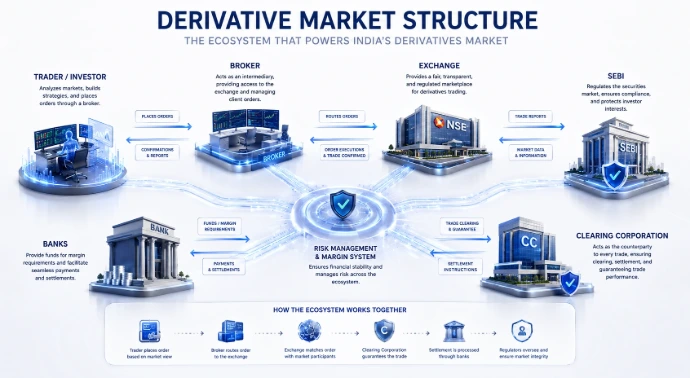
MARKET
INDIA
Popular Derivative Instruments in India
The most actively traded derivative instruments across equity, currency, and commodity segments.
📊 Derivative Market Overview
India's F&O market — world's largest by volume
📈 Futures & Options
Core instruments of derivative trading
🛡️ Risk Management
Essential framework for trading success
Nifty 50 Derivatives
The most liquid derivatives in India. Weekly and monthly expiry. Accounts for the largest share of NSE F&O turnover globally.
Bank Nifty Derivatives
Second most popular. High volatility and premium values. Extremely popular among intraday options traders for weekly expiry strategies.
Sensex Derivatives
BSE's flagship index derivatives. Growing popularity with competitive pricing and increasing institutional participation on BSE.
Stock Derivatives
F&O on 200+ individual stocks. Reliance, TCS, HDFC Bank, Infosys, ICICI Bank, Tata Motors, Bajaj Finance are most traded.
Currency Derivatives
USD/INR, EUR/INR, GBP/INR, JPY/INR futures and options for forex hedging and speculation by importers and exporters.
Commodity Derivatives
Gold, Silver, Crude Oil, Natural Gas, Copper, and agricultural commodities on MCX and NCDEX for hedging and diversification.
Beginner's Guide to Start Derivative Trading
Follow this structured step-by-step roadmap to begin your derivative trading journey in India with confidence.
Open a Trading & Demat Account
Choose a SEBI-registered broker offering F&O trading. Compare brokerage charges, platform features, margin policies, and customer support quality.
Complete KYC & Enable F&O Segment
Complete KYC with PAN, Aadhaar, address proof, and bank details. Request F&O segment activation — it requires separate approval and income documentation.
Learn the Fundamentals Thoroughly
Study futures, options, lot sizes, margins, expiry cycles, Greeks (Delta, Gamma, Theta, Vega), and basic strategies. NISM certification courses are excellent.
Master Risk Management First
Never risk more than 1-2% of capital per trade. Set stop-losses before entering. Define risk-reward ratios. Risk management is the most critical survival skill.
Start with Small Positions
Begin with a single lot in highly liquid instruments like Nifty options. Paper trading is strongly recommended before deploying real capital.
Track Open Interest & Market Data
Monitor option chain data, OI changes, PCR, implied volatility, and volume patterns. Use Option Matrix India's Live Option Chain for real-time insights.
Always Use Stop-Loss Orders
Never trade without a predefined stop-loss. Trail stops to lock profits as positions move favourably. Discipline is non-negotiable.
Derivative Trading Glossary
Master these essential terms and concepts to navigate the derivative market with confidence.
Frequently Asked Questions About Derivative Trading
Comprehensive answers to the most commonly asked questions — from basics to advanced derivative trading concepts.
Derivative trading involves buying and selling financial contracts whose value is derived from an underlying asset such as stocks, indices, commodities, or currencies. Common derivatives include futures and options contracts traded on exchanges like NSE and BSE. It allows speculation, hedging, and arbitrage with leverage.
F&O trading works through NSE and BSE. Traders buy or sell futures/options by paying margin. Futures obligate both parties to honour the contract, while options give the buyer the right but not obligation. Settlement is primarily cash-based during 9:15 AM–3:30 PM IST.
Yes, completely legal and regulated by SEBI through recognized exchanges like NSE, BSE, and MCX. SEBI has comprehensive rules ensuring market integrity, investor protection, and fair trading practices.
Margin is the collateral required by the exchange to open and maintain positions. Types include Initial Margin (to open), Maintenance Margin (to keep open), and Exposure Margin. If margin falls below required levels, a margin call is triggered.
Neither is universally better — it depends on goals and risk tolerance. Futures: simple, no time decay, unlimited risk. Options: flexible, limited risk for buyers, time decay. Many beginners start with options buying for defined risk.
Yes, significant risk from leverage, volatility, and complexity. SEBI studies show majority of retail F&O traders incur losses. Risk can be managed through education, position sizing, stop-losses, and disciplined practices.
Yes, but gain proper education first. Learn lot size, margin, expiry, and strategies. Paper trade, start small, and focus on risk management. NISM certification courses provide structured foundational learning.
Nifty options buying: ₹5,000–₹15,000 per lot. Futures trading: ₹50,000 to several lakhs. Start with affordable capital and increase gradually as you gain experience and consistency.
OI = total outstanding unsettled contracts. Indicates activity, liquidity, and trend strength. Rising OI + rising price = bullish. Rising OI + falling price = bearish. Helps identify support/resistance levels.
Fixed expiry dates. Weekly options: every Thursday. Monthly: last Thursday. If Thursday is a holiday, previous trading day. After expiry, positions are settled via cash or physical delivery.
Futures and options on the Nifty 50 index (top 50 NSE companies). Most liquid derivatives in India with weekly and monthly expiry. Used for hedging, directional trading, and income generation.
F&O contracts on Nifty Bank index tracking major banking stocks. Extremely popular among intraday traders due to high volatility, large premiums, and weekly expiry availability.
Call = right to buy (bullish). Put = right to sell (bearish). Call buyers profit when prices rise; put buyers profit when prices fall. Sellers of both collect premium and profit when options expire worthless.
Minimum units per contract. Trade in multiples of lot size. Exchange-determined, varies by stock/index, periodically revised to maintain reasonable contract values.
F&O profits = non-speculative business income, taxed per your slab. Losses can be set off against other income (except salary) and carried forward 8 years. Tax audit may be required under Section 44AB.
Using derivatives to offset portfolio losses. If you hold ₹10L in stocks, buying Nifty puts protects value. Puts gain if markets fall, compensating for stock losses — portfolio insurance.
Market's expectation of future price movement derived from option prices. Higher IV = higher premiums = expensive options. Compare current IV to historical levels to time entries.
Daily erosion of option value as expiry approaches. Accelerates near expiry, especially for OTM options. Buyers are hurt; sellers benefit. Critical factor in options pricing.
SEBI is the primary regulator — sets margins, position limits, F&O stock eligibility, trading rules, settlement procedures. Ensures market integrity, protects investors, monitors manipulation.
Yes, on MCX (metals, energy) and NCDEX (agricultural). Gold, silver, crude oil, natural gas, copper, zinc and more. Need a commodity trading account with a SEBI-registered broker.
Put OI ÷ Call OI. PCR > 1 = bearish sentiment (more puts). PCR < 1 = bullish (more calls). Extreme values may signal contrarian reversal opportunities.
European: exercised only at expiry. American: anytime before expiry. In India, index options (Nifty, Bank Nifty) are European style; stock options are American style.
Option Matrix India — Premium Trading Tools
Enhance your derivative trading with our powerful, free tools built for Indian market participants.
Conclusion: Navigating the Derivative Market with Confidence
The Indian derivative market is one of the most dynamic segments of the global financial ecosystem. With proper education, disciplined risk management, and a structured approach, derivative trading becomes a powerful tool for wealth creation and portfolio protection.
Derivative Trading in India: Complete Guide to Futures & Options Market
Master the fundamentals of derivative trading, understand futures and options, learn proven F&O strategies, and navigate the Indian derivative market with confidence. Your complete educational resource for informed trading decisions.
What is Derivative Trading?
Understanding the core concept behind one of the world's largest and most dynamic financial markets — the derivative market.
Derivative trading involves buying and selling financial contracts whose value is derived from an underlying asset. These underlying assets can be stocks, indices, commodities, currencies, or interest rates. Unlike direct asset ownership, derivatives are contracts between two or more parties that derive their value from the performance of the underlying entity.
In the Indian derivative market, traders use instruments like futures contracts and options contracts to speculate on price movements, hedge existing portfolio risk, or engage in arbitrage opportunities. The derivative market in India is primarily governed by the Securities and Exchange Board of India (SEBI) and operates through exchanges like the National Stock Exchange (NSE) and Bombay Stock Exchange (BSE).
For example, if a trader believes that the Nifty 50 index will rise from its current level, they can buy a Nifty futures contract or purchase a Nifty call option instead of buying all 50 stocks individually. This provides leverage, meaning they can control a large position with a relatively smaller amount of capital known as margin.
According to NSE data, India has emerged as the world's largest derivative market by volume, with billions of contracts traded annually. This explosive growth underscores the importance of understanding derivative trading for every market participant.
Key Components of Derivative Contracts
Underlying Asset
The financial instrument from which the derivative derives its value — stocks, indices, commodities, currencies, or bonds.
Contract Value
The total monetary value of the contract, calculated as price of the underlying asset multiplied by the lot size.
Expiry Date
The date on which the contract expires and must be settled. Monthly contracts expire on the last Thursday in India.
Margin Requirement
The collateral deposit required by the exchange to initiate and maintain a derivative position.
History of Derivative Trading in India
The Indian derivative market has evolved remarkably since its inception — from informal forward trading to a world-leading exchange-traded derivatives ecosystem.
Types of Derivatives in India
The Indian derivative market offers four primary types of instruments. Understanding each is essential for informed trading decisions.
Futures Contracts
A futures contract is a standardized legal agreement to buy or sell an underlying asset at a predetermined price on a specified future date. Both buyer and seller are obligated to honour the contract at expiry.
Key Features
- Standardized contracts traded on exchanges
- Obligation for both buyer and seller
- Daily mark-to-market settlement
- Margin-based trading with leverage
- Cash settled in India (mostly)
Advantages & Risks
Advantages: Simple structure, transparent pricing, high liquidity, no premium cost, profit from both directions.
Risks: Unlimited loss potential, daily margin requirements, compulsory settlement at expiry.
Options Contracts
An options contract gives the buyer the right, but not the obligation, to buy (call) or sell (put) an underlying asset at a specified strike price on or before the expiry date.
Key Features
- Right but not obligation for buyer
- Premium paid upfront by buyer
- Call Options (bullish) & Put Options (bearish)
- Multiple strike prices available
- Weekly and monthly expiry cycles
Advantages & Risks
Advantages: Limited risk for buyers, multiple strategy combinations, flexibility, hedging capability.
Risks: Time decay erodes value, sellers face unlimited risk, complexity of option Greeks.
Forward Contracts
A forward contract is a customized private agreement between two parties to buy or sell an asset at a specified price on a future date. Unlike futures, forwards are OTC instruments — not traded on exchanges.
- Customized, non-standardized contracts
- No margin requirements typically
- Settlement at maturity only
- Counterparty risk exists
Primarily used by corporates, banks, and institutions for customized hedging needs.
Swap Contracts
A swap is a derivative in which two parties exchange cash flows or financial instruments over a period. Interest rate swaps and currency swaps are the most common types.
- Exchange of cash flow streams
- Primarily OTC instruments
- Used by corporates and institutions
- Regulated by RBI and SEBI in India
Efficient for managing interest rate exposure, currency risk, and optimizing corporate cash flows.
Major Derivative Segments in India
The Indian derivative market is divided into four major segments, each serving distinct trading and hedging purposes.
Stock Futures & Stock Options
Individual stock derivatives on 200+ NSE-listed stocks. Popular F&O stocks include Reliance, TCS, HDFC Bank, Infosys, ICICI Bank, Bajaj Finance, SBI, and Tata Motors.
Index Futures & Index Options
Derivatives on Nifty 50, Bank Nifty, FinNifty, Sensex and more. The most actively traded segment with weekly and monthly expiry cycles.
Currency Derivatives
Futures and options on USD/INR, EUR/INR, GBP/INR, JPY/INR. Used by importers, exporters, and forex traders for hedging and speculation.
Commodity Derivatives
Trade on MCX (metals, energy) and NCDEX (agricultural). Popular: Gold, Silver, Crude Oil, Natural Gas, Copper, Zinc, Cotton, Soybean.
Interest Rate Derivatives
Based on government securities and T-bills. Used by banks and institutions for managing duration risk and fixed-income portfolio optimization.
How Derivative Trading Works
Understanding the complete workflow is essential before placing your first derivative trade in the Indian market.
Why Traders Use Derivatives
Derivatives serve multiple purposes — hedging, speculation, arbitrage, and income generation in the financial ecosystem.
Hedging
Protect portfolios and business against adverse price movements. Buy put options as insurance against market crashes.
Example: Exporter hedges INR appreciation via USD/INR futures.
Speculation
Profit from expected price movements without owning the underlying. Leverage amplifies both potential gains and losses.
Example: Buying Nifty call options before a bullish event.
Arbitrage
Exploit price discrepancies between related markets for risk-free profits. Buy in one market, sell simultaneously in another.
Example: Cash-futures arbitrage when premium is unusually high.
Income Generation
Options sellers collect premiums as income. Covered calls, iron condors, and credit spreads generate consistent theta income.
Example: Selling weekly OTM Nifty options for premium collection.
Portfolio Protection
Institutional investors buy index puts as insurance during uncertain periods to protect against significant drawdowns.
Example: Fund manager buys Nifty puts before election results.
Risk Management
Define exact risk parameters through position sizing, delta hedging, and spread strategies for systematic exposure management.
Example: Bull call spreads to limit both max profit and max loss.
Benefits of Derivative Trading
Derivative trading offers key advantages making it an attractive segment for traders and investors in India.
Leverage & Capital Efficiency
Control large positions with a fraction of capital. Margin-based trading amplifies market exposure, maximizing returns on deployed capital while trading multiple instruments simultaneously.
High Liquidity
Nifty and Bank Nifty options are among the most liquid globally. Tight bid-ask spreads ensure efficient, cost-effective trade execution at any scale.
Hedging & Protection
Protect stock portfolios against downturns using put options. Derivatives serve as insurance for existing investments during uncertain markets.
Strategic Flexibility
From directional bets to non-directional income strategies — combine options for custom risk-reward profiles tailored to any market condition.
Risks of Derivative Trading
Derivatives carry substantial risks. Understanding and managing these risks is essential for survival and success.
Leverage Risk
Leverage amplifies losses equally as gains. Small adverse moves can cause losses exceeding initial margin, triggering margin calls.
Market Volatility
Sudden extreme movements from earnings, geopolitical events, or policy changes can trigger violent price swings and rapid capital erosion.
Time Decay (Theta)
Options lose value daily. Decay accelerates near expiry, especially for OTM options. Buyers are adversely affected; sellers benefit from theta.
Margin Calls
Positions moving against you trigger margin calls. Failure to add funds leads to forced liquidation at unfavourable prices by the broker.
Liquidity Risk
Far OTM options and less popular stocks may have wide spreads, making entry/exit difficult at desired prices.
Emotional Trading
Fast-paced trading triggers revenge trading, overtrading, or holding losers too long. Discipline and a plan are non-negotiable.
⚡ Important Risk Disclaimer
Derivative trading involves substantial risk of loss and is not suitable for all investors. According to SEBI studies, a significant majority of individual F&O traders incur net losses. Past performance does not guarantee future results. Only trade with capital you can afford to lose. Seek independent financial advice if needed.
Futures vs Options: Comprehensive Comparison
Understanding the fundamental differences between futures and options contracts is critical for making the right trading decisions.
| Parameter | Futures Contract | Options Contract |
|---|---|---|
| Obligation | Both buyer and seller are obligated to honour the contract | Buyer has the right, not obligation. Seller is obligated. |
| Risk (Buyer) | Unlimited — both upside and downside | Limited to the premium paid |
| Risk (Seller) | Unlimited — both upside and downside | Unlimited for naked option selling |
| Profit Potential | Unlimited in both directions | Unlimited for buyers; limited to premium for sellers |
| Upfront Cost | Margin (typically 10-20% of contract value) | Premium (buyers); Margin (sellers) |
| Margin | High — initial + maintenance margin required | Buyers: Premium only. Sellers: Margin required |
| Expiry | Monthly expiry (last Thursday) | Weekly & Monthly expiry available |
| Strategy | Simple — long or short only | Complex — multi-leg strategies possible |
| Time Decay | No direct time decay impact | Significant — Theta erodes value daily |
| Leverage | High leverage through margin | Built-in leverage; varies by moneyness |
| Settlement | Cash settled (or physical delivery) | Cash settled (or physical delivery for stock options) |
| Best For | Directional traders with strong conviction | Flexible strategies, income generation, defined risk |
Derivative Market Structure in India
The Indian derivative market operates through a well-organized ecosystem of participants, intermediaries, and regulatory bodies.
MARKET
INDIA
Popular Derivative Instruments in India
The most actively traded derivative instruments across equity, currency, and commodity segments.
📊 Derivative Market Overview
India's F&O market — world's largest by volume
📈 Futures & Options
Core instruments of derivative trading
🛡️ Risk Management
Essential framework for trading success
Nifty 50 Derivatives
The most liquid derivatives in India. Weekly and monthly expiry. Accounts for the largest share of NSE F&O turnover globally.
Bank Nifty Derivatives
Second most popular. High volatility and premium values. Extremely popular among intraday options traders for weekly expiry strategies.
Sensex Derivatives
BSE's flagship index derivatives. Growing popularity with competitive pricing and increasing institutional participation on BSE.
Stock Derivatives
F&O on 200+ individual stocks. Reliance, TCS, HDFC Bank, Infosys, ICICI Bank, Tata Motors, Bajaj Finance are most traded.
Currency Derivatives
USD/INR, EUR/INR, GBP/INR, JPY/INR futures and options for forex hedging and speculation by importers and exporters.
Commodity Derivatives
Gold, Silver, Crude Oil, Natural Gas, Copper, and agricultural commodities on MCX and NCDEX for hedging and diversification.
Beginner's Guide to Start Derivative Trading
Follow this structured step-by-step roadmap to begin your derivative trading journey in India with confidence.
Open a Trading & Demat Account
Choose a SEBI-registered broker offering F&O trading. Compare brokerage charges, platform features, margin policies, and customer support quality.
Complete KYC & Enable F&O Segment
Complete KYC with PAN, Aadhaar, address proof, and bank details. Request F&O segment activation — it requires separate approval and income documentation.
Learn the Fundamentals Thoroughly
Study futures, options, lot sizes, margins, expiry cycles, Greeks (Delta, Gamma, Theta, Vega), and basic strategies. NISM certification courses are excellent.
Master Risk Management First
Never risk more than 1-2% of capital per trade. Set stop-losses before entering. Define risk-reward ratios. Risk management is the most critical survival skill.
Start with Small Positions
Begin with a single lot in highly liquid instruments like Nifty options. Paper trading is strongly recommended before deploying real capital.
Track Open Interest & Market Data
Monitor option chain data, OI changes, PCR, implied volatility, and volume patterns. Use Option Matrix India's Live Option Chain for real-time insights.
Always Use Stop-Loss Orders
Never trade without a predefined stop-loss. Trail stops to lock profits as positions move favourably. Discipline is non-negotiable.
Derivative Trading Glossary
Master these essential terms and concepts to navigate the derivative market with confidence.
Frequently Asked Questions About Derivative Trading
Comprehensive answers to the most commonly asked questions — from basics to advanced derivative trading concepts.
Derivative trading involves buying and selling financial contracts whose value is derived from an underlying asset such as stocks, indices, commodities, or currencies. Common derivatives include futures and options contracts traded on exchanges like NSE and BSE. It allows speculation, hedging, and arbitrage with leverage.
F&O trading works through NSE and BSE. Traders buy or sell futures/options by paying margin. Futures obligate both parties to honour the contract, while options give the buyer the right but not obligation. Settlement is primarily cash-based during 9:15 AM–3:30 PM IST.
Yes, completely legal and regulated by SEBI through recognized exchanges like NSE, BSE, and MCX. SEBI has comprehensive rules ensuring market integrity, investor protection, and fair trading practices.
Margin is the collateral required by the exchange to open and maintain positions. Types include Initial Margin (to open), Maintenance Margin (to keep open), and Exposure Margin. If margin falls below required levels, a margin call is triggered.
Neither is universally better — it depends on goals and risk tolerance. Futures: simple, no time decay, unlimited risk. Options: flexible, limited risk for buyers, time decay. Many beginners start with options buying for defined risk.
Yes, significant risk from leverage, volatility, and complexity. SEBI studies show majority of retail F&O traders incur losses. Risk can be managed through education, position sizing, stop-losses, and disciplined practices.
Yes, but gain proper education first. Learn lot size, margin, expiry, and strategies. Paper trade, start small, and focus on risk management. NISM certification courses provide structured foundational learning.
Nifty options buying: ₹5,000–₹15,000 per lot. Futures trading: ₹50,000 to several lakhs. Start with affordable capital and increase gradually as you gain experience and consistency.
OI = total outstanding unsettled contracts. Indicates activity, liquidity, and trend strength. Rising OI + rising price = bullish. Rising OI + falling price = bearish. Helps identify support/resistance levels.
Fixed expiry dates. Weekly options: every Thursday. Monthly: last Thursday. If Thursday is a holiday, previous trading day. After expiry, positions are settled via cash or physical delivery.
Futures and options on the Nifty 50 index (top 50 NSE companies). Most liquid derivatives in India with weekly and monthly expiry. Used for hedging, directional trading, and income generation.
F&O contracts on Nifty Bank index tracking major banking stocks. Extremely popular among intraday traders due to high volatility, large premiums, and weekly expiry availability.
Call = right to buy (bullish). Put = right to sell (bearish). Call buyers profit when prices rise; put buyers profit when prices fall. Sellers of both collect premium and profit when options expire worthless.
Minimum units per contract. Trade in multiples of lot size. Exchange-determined, varies by stock/index, periodically revised to maintain reasonable contract values.
F&O profits = non-speculative business income, taxed per your slab. Losses can be set off against other income (except salary) and carried forward 8 years. Tax audit may be required under Section 44AB.
Using derivatives to offset portfolio losses. If you hold ₹10L in stocks, buying Nifty puts protects value. Puts gain if markets fall, compensating for stock losses — portfolio insurance.
Market's expectation of future price movement derived from option prices. Higher IV = higher premiums = expensive options. Compare current IV to historical levels to time entries.
Daily erosion of option value as expiry approaches. Accelerates near expiry, especially for OTM options. Buyers are hurt; sellers benefit. Critical factor in options pricing.
SEBI is the primary regulator — sets margins, position limits, F&O stock eligibility, trading rules, settlement procedures. Ensures market integrity, protects investors, monitors manipulation.
Yes, on MCX (metals, energy) and NCDEX (agricultural). Gold, silver, crude oil, natural gas, copper, zinc and more. Need a commodity trading account with a SEBI-registered broker.
Put OI ÷ Call OI. PCR > 1 = bearish sentiment (more puts). PCR < 1 = bullish (more calls). Extreme values may signal contrarian reversal opportunities.
European: exercised only at expiry. American: anytime before expiry. In India, index options (Nifty, Bank Nifty) are European style; stock options are American style.
Option Matrix India — Premium Trading Tools
Enhance your derivative trading with our powerful, free tools built for Indian market participants.
Conclusion: Navigating the Derivative Market with Confidence
The Indian derivative market is one of the most dynamic segments of the global financial ecosystem. With proper education, disciplined risk management, and a structured approach, derivative trading becomes a powerful tool for wealth creation and portfolio protection.