
5 Minute Nifty Scalping Strategy: Simple Setup for Intraday Profits
If you want fast intraday trades in Nifty without staring at the screen all day, a structured 5 minute Nifty scalping strategy is one of the cleanest ways to start.
Scalping has become extremely popular among Indian retail traders because it aims for small, repeatable profits in minutes rather than hunting for big moves. With the right rules, indicators, and risk management, even beginners and students can use a 5-minute chart to build a disciplined intraday routine in Nifty.
What Is 5-Minute Nifty Scalping?
Scalping is an intraday style where traders try to capture tiny price moves many times during the day instead of holding trades for hours or days. Positions typically last from a few seconds to about 30 minutes, with small targets repeated again and again.
In the context of Nifty and Bank Nifty, scalpers often look for 10–30 points on the index or equivalent points on options premiums per trade, repeated multiple times with strict discipline. The 5-minute timeframe sits in a sweet spot: it is fast enough for intraday scalping, but not as noisy and stressful as 1‑minute charts for most beginners.
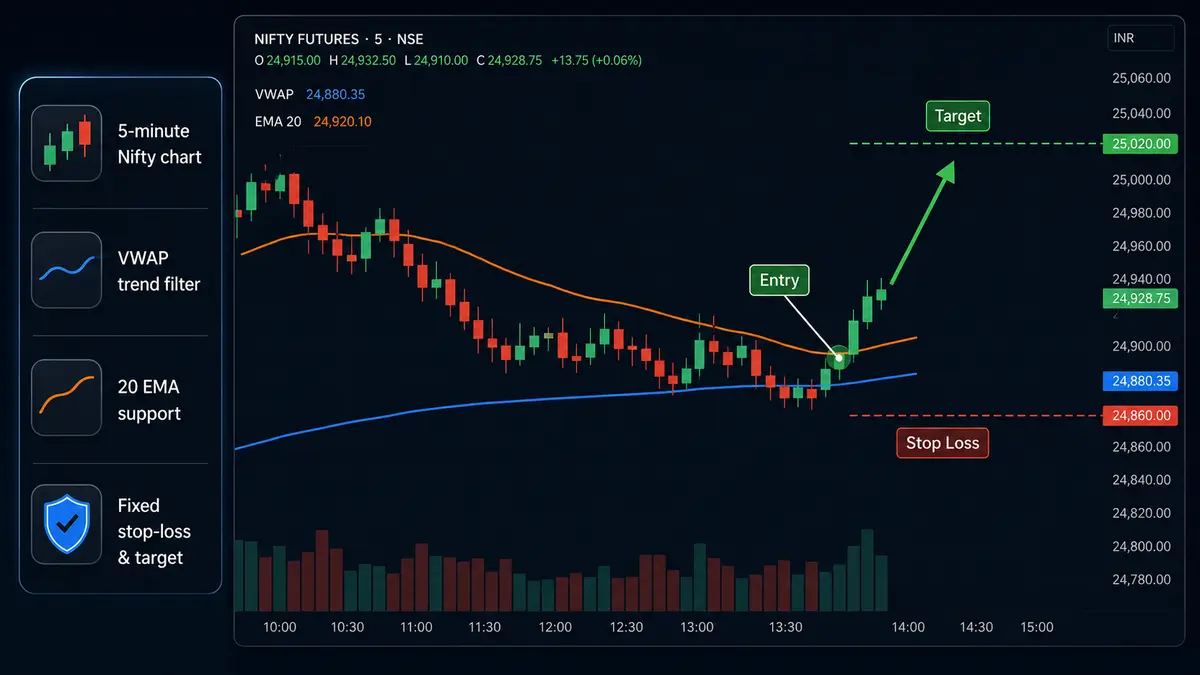
Why Focus on a 5-Minute Timeframe?
The 5-minute chart filters out a lot of random ticks while still giving enough trading opportunities during active sessions. Many popular scalping setups in Indian markets use 3–5 minute candles along with tools like VWAP, CPR, and short moving averages.
For beginners, the 5-minute timeframe also helps you:
Avoid overtrading every minor tick.
See clear trend swings and pullbacks on Nifty.
Execute and manage trades without rushing every few seconds.
Several Indian brokers and education portals highlight scalping and breakout styles as common intraday strategies, especially when combined with technical indicators and previous day levels.
Core Tools for a 5 Minute Nifty Scalping Strategy
Before you worry about entries and exits, set up your chart with the right tools. Indian scalpers in Nifty and Bank Nifty commonly use:
5-minute candlestick chart for Nifty, Nifty Futures, or Nifty options.
VWAP (Volume Weighted Average Price) to track where institutional money is likely averaging positions.
20-period Exponential Moving Average (20 EMA) to define the short-term trend and dynamic support/resistance.
Momentum indicator – usually RSI or MACD – to confirm whether momentum supports the direction of your trade.
Key price levels – previous day high/low, opening range, and important intraday swing highs/lows.
These tools are widely used in live Nifty and Bank Nifty scalping rooms, particularly combinations of VWAP + EMA + simple momentum filters.
Market Session Rules for Beginners
Volatility during the first few minutes of market open can be brutal for new traders. Many beginner guides specifically recommend avoiding the first 15–30 minutes until the market stabilises.
For a 5 minute Nifty scalping strategy as a student or beginner, a good rule of thumb is:
Skip 9:15–9:30 AM to avoid wild opening noise.
Focus on 9:30–11:00 AM and 1:30–3:00 PM, when Nifty often shows clearer directional moves and decent volume.
Pro Tip: On days with very narrow CPR or strong global cues, indices can trend strongly, making scalping opportunities much cleaner.
The Core 5 Minute Nifty Scalping Strategy (Step-by-Step)
This setup is designed to be simple, rule-based, and friendly for beginners:
Step 1: Define the Trend with VWAP and 20 EMA
Use the combination of VWAP + 20 EMA on the 5-minute chart:
If price is above both VWAP and 20 EMA, and VWAP is sloping up → bias is bullish.
If price is below both VWAP and 20 EMA, and VWAP is sloping down → bias is bearish.
Many intraday scalping methods work by first identifying the trend and only taking trades in that direction, rather than guessing reversals.
Step 2: Mark Key Levels
Before the session or before starting to trade, mark:
Previous day high and low on the chart.
Today’s opening range (first 15–30 minutes high and low).
Any obvious intraday swing high/low formed after 9:30 AM on the 5-minute chart.
Scalpers in Nifty and Bank Nifty often rely on support/resistance levels and opening ranges as core decision zones for entries and exits.
Long Setup: Buying Small Upside Moves
Use this when the 5 minute Nifty scalping strategy is bullish according to your trend filter.
Entry Rules for Long Trades
You can look for long entries when:
Trend filter: Price is above both VWAP and 20 EMA, and VWAP is turning or sloping upward.
Pullback: Price pulls back towards the 20 EMA / VWAP zone without breaking a key support (previous day low or strong intraday swing low).
Confirmation candle: A bullish candle (strong body, small lower wick) forms from that zone, suggesting buyers are stepping in.
Momentum check:
RSI is above 50 but not in extreme overbought territory (e.g., below 70), or
MACD is above the signal line, showing positive momentum.
Once all conditions align, you can enter a Call option or Nifty long position at the close of the confirmation candle, targeting a small intraday move.
Stop-Loss and Targets for Longs
Scalping works only when you are strict with exits. Common guidelines from scalping and intraday risk management articles include:
Stop-loss:
Just below the low of the setup candle, or
Just below the recent 5-minute swing low, or
Predefined points (for example 8–12 points) if your backtesting supports it.
Target:
1.5–2 times your risk (1:1.5 or 1:2 risk–reward), or
A fixed small point target such as 10–20 index points or 15–25 points on the option premium.
Trade management:
Consider partial profit booking and move stop-loss to breakeven after the first target is hit, a method many live scalpers demonstrate when trailing positions.
Short Setup: Selling Short-Term Downside
Use this when the 5 minute Nifty scalping strategy turns bearish.
Entry Rules for Short Trades
Conditions for short trades:
Trend filter: Price is below both VWAP and 20 EMA, with VWAP sloping downward.
Pullback: Nifty price pulls back towards VWAP / 20 EMA from below, without breaking an important resistance such as the day’s high or a strong swing high.
Confirmation candle: A bearish candle with a strong body and upper wick forms from the zone, suggesting sellers are stepping back in.
Momentum check:
RSI is below 50, or
MACD is below the signal line, showing negative momentum.
You can enter a Put option or short Nifty Futures as the bearish candle closes, aiming for a quick downside move.
Stop-Loss and Targets for Shorts
Risk management logic mirrors the long setup:
Stop-loss:
Just above the high of the confirmation candle, or
Above the recent 5-minute swing high, or
A fixed-point stop that fits your risk appetite.
Target:
Aim for a 1:1.5 or 1:2 risk–reward ratio, or
Use small point targets similar to long trades (10–20 index points / 15–25 option points).
Risk Management Rules for Beginners & Students
Every serious intraday guide emphasises that scalping only works when risk management is strict. This is even more important for students and small-capital traders.
Key rules you can adopt:
Risk only 1–2% of your trading capital per trade, a widely suggested limit in intraday education resources.
Avoid overtrading. Many guides explicitly warn that taking too many trades reduces focus and increases costs.
Always place a stop-loss at the time of entry, not later, to avoid emotional exits.
Stick to liquid instruments like Nifty index and its liquid options for better fills and tighter spreads.
Reminder: Scalping in Nifty is high-intensity. If you feel emotional or start revenge trading after a loss, stop trading for the day.
Quick Comparison: 5-Minute Scalping vs Swing Trading
| Aspect | 5-Minute Nifty Scalping | Swing Trading in Nifty |
|---|---|---|
| Holding period | Seconds to 30 minutes | Several days to weeks |
| Chart timeframe | 1–5 minute charts | 1-hour to daily charts |
| Profit per trade | Small, frequent gains | Larger, less frequent moves |
| Trade frequency | Many trades per day | Few trades per month |
| Stress level | High focus, fast decisions | Slower, more analysis-based |
Adapting to Current Market Conditions (2025–2026 Context)
Recent Indian market education content highlights how scalping has become one of the most popular short-term trading styles among retail traders, especially in volatile index instruments like Nifty and Bank Nifty.
Some current themes you should factor into your 5 minute nifty scalping strategy:
Intraday volatility spikes around macro news, RBI policy, and global events create sharp scalping opportunities but also bigger slippage risk.
Many scalpers now blend price action with VWAP and CPR to align with how institutions and algos are believed to operate intraday.
There is a clear shift towards rule-based and systematic scalping, using predefined entries, exits, and risk levels instead of pure intuition.
Treat your rules as a “mini-algo” you follow manually: same timeframe, same risk per trade, same entry filters, every day.
Common Mistakes to Avoid
Beginners in Nifty scalping often lose money not because the 5-minute strategy is bad, but because of basic errors that most education portals repeatedly warn against:
Trading during the opening chaos without experience or a tested opening-range method.
Ignoring stop-losses and letting a scalp turn into a large positional loss.
Overleveraging in options or futures far beyond safe position sizing.
Taking trades against the dominant intraday trend instead of using the VWAP/EMA filters.
How to Practise This 5 Minute Nifty Scalping Strategy
To make this 5 minute nifty scalping strategy truly your own:
Backtest on past charts: Scroll through a few months of 5-minute Nifty data and manually mark where your rules would trigger trades.
Paper trade first: Many modern platforms allow real-time paper trading; use this to build confidence before risking capital.
Track stats: Record win rate, average reward-to-risk, maximum consecutive losses, and which time windows work best for you.
Over time, you can add refinements like skipping low-volume days, avoiding major event days, or tightening rules for choppy markets based on your own data.
FAQ: 5 Minute Nifty Scalping Strategy
1. Is the 5-minute Nifty scalping strategy good for complete beginners?
Yes, if you keep the rules simple and risk very small amounts per trade. Educational content for beginners suggests starting with clear technical setups, strict stop-losses, and limited daily trades rather than random scalping.
2. Which is better for this setup: Nifty Futures or Nifty Options?
Both can work, but many Indian scalpers use near-month, liquid Nifty options because they require lower capital and can capture quick premium moves, as seen in common Nifty intraday option trading examples. For absolute beginners, options with defined risk (using stop-loss) are often more accessible than leveraged futures.
3. How many trades should I take in a day with a 5-minute Nifty scalping strategy?
Scalping guides mention that professionals may take dozens of trades, but beginners are better off taking a few high-quality trades and avoiding overtrading. Start with 2–5 carefully selected setups in your chosen time windows, then scale up only after you have consistent data.
4. Can I use this 5-minute scalping ruleset on Bank Nifty as well?
The same VWAP + 20 EMA + momentum structure is commonly used in both Nifty and Bank Nifty scalping, because both indices are liquid and move sharply intraday. However, Bank Nifty tends to be more volatile, so your stop-loss and position sizing must be adjusted accordingly.
Final Thoughts & Actionable Next Steps
A 5 minute Nifty scalping strategy is not a magic formula, but it can be a powerful framework for intraday trading if you treat it like a serious skill. You are using widely adopted tools—VWAP, 20 EMA, key levels, and momentum filters—within a clear set of rules that match modern index scalping practices in India.
Your next steps:
Set up your chart with 5-minute Nifty, VWAP, 20 EMA, and RSI/MACD.
Follow the trend-filter + pullback + confirmation + tight stop structure for both long and short trades.
Practise on historical data, then paper trade live, and only then trade with real money and small size.
This way, your 5 minute nifty scalping strategy becomes a disciplined process instead of a series of random, emotional intraday bets.